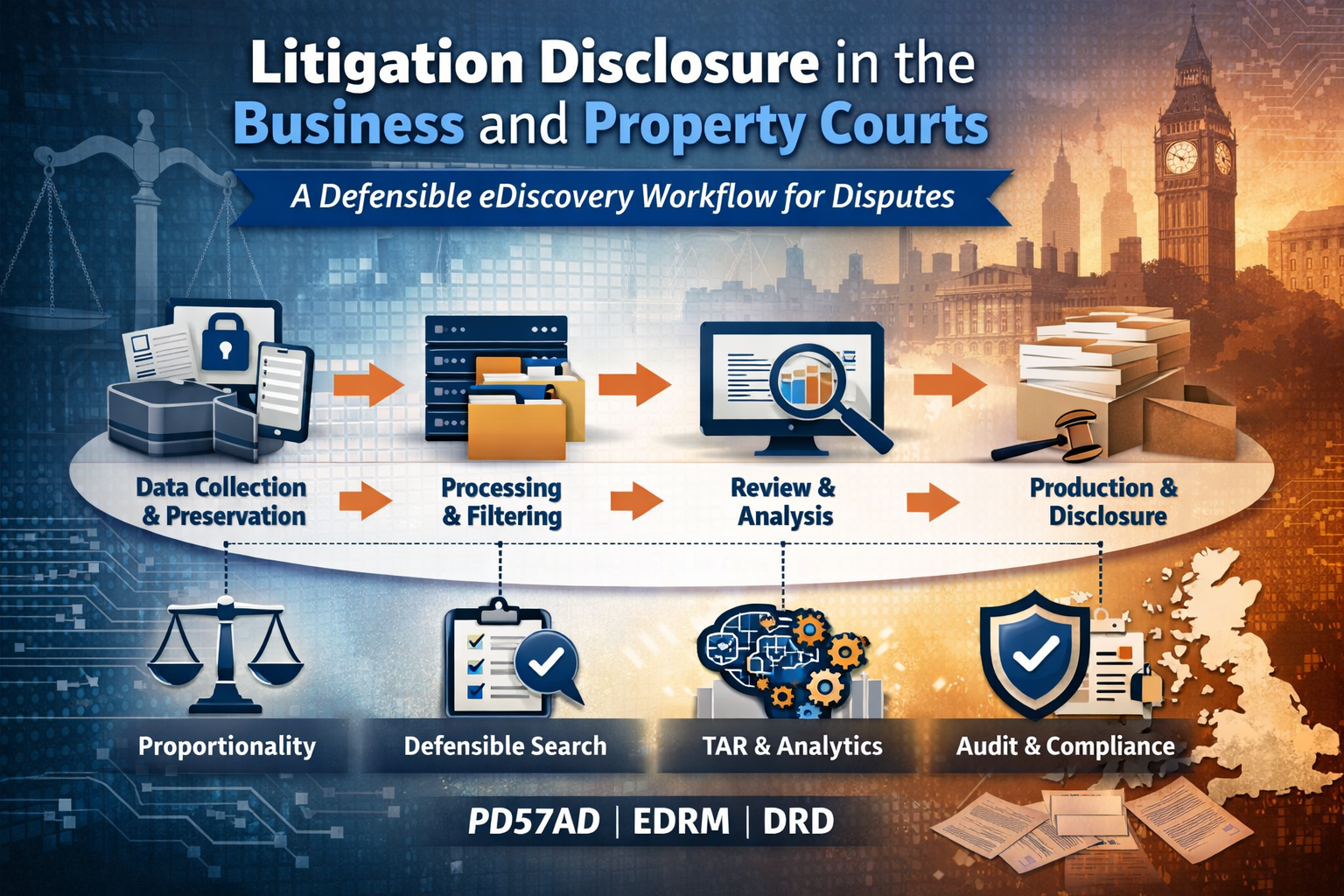
Reducing Risk in Request for Information (RFI) Responses: How eDiscovery and eSearch Software Support Compliance
When competition authorities issue a Request for Information (RFI), the clock starts ticking. For legal teams, it’s a balancing act between precision and speed — locating relevant evidence, ensuring nothing material is missed, and protecting privileged or confidential information.
In practice, however, the challenge isn’t only legal; it’s technological. Modern RFIs often require the extraction, review, and production of thousands to millions of documents across email, chat, cloud, and mobile data sources — often under immense time pressure. The margin for error is small, and the reputational and financial risks of getting it wrong can be significant.
Understanding the RFI Challenge
Competition RFIs are not like standard disclosure exercises. They are highly structured, with specific questions and data formats, frequently spanning multiple jurisdictions. Authorities expect accurate, traceable, and defensible responses — and they expect them fast.
The reality is that internal IT systems rarely align neatly with how lawyers need to present data. Employee’s use a mix of personal devices, WhatsApp messages, and cloud collaboration tools that can hold key evidence but pose real challenges for collection and review.
This is where eDiscovery and eSearch software play a decisive role.
Building a Defensible Workflow
A defensible workflow starts with data identification. The ability to quickly map data sources — including email archives, Microsoft 365 environments, and mobile applications — reduces the risk of missing key materials. Forensic collection ensures integrity and provides an audit trail that satisfies regulators.
Once collected, the data must be processed and normalised so it can be reviewed and searched consistently. Advanced eDiscovery platforms such as #Reveal can automatically deduplicate, thread emails, and apply analytics to group similar documents — saving time and reducing review volume.
Crucially, AI-assisted review can surface documents most likely to be responsive to specific RFI questions, allowing lawyers to focus their attention where it matters most. For complex competition requests, this means faster turnaround and greater consistency across teams and jurisdictions.
Managing Privacy and Cross-Border Constraints
In EU-based investigations, compliance with privacy laws remains a critical consideration. Data minimisation, redaction, and structured metadata handling are essential to avoid inadvertent breaches of GDPR or national data-protection laws.
Modern eDiscovery and eSearch tools can automate much of this — identifying personal data, flagging sensitive fields, and applying rule-based redactions before production. Working with a technology partner familiar with these requirements ensures that the data is both compliant and regulator-ready.
Maintaining Quality Under Pressure
RFIs are often issued at short notice and require rapid coordination between legal teams, clients, and external vendors. The combination of human oversight and technology is what keeps quality high under pressure.
A well-structured workflow includes:
- Early identification of data custodians and devices
- Clear preservation and collection protocols
- Use of analytics and search validation to confirm completeness
- Controlled production with metadata verification
At Legal Tech Innovations (LTI), we’ve supported law firms and their clients through precisely these challenges — from initial scoping to final delivery — helping ensure that every produced document stands up to regulator scrutiny.
A Smarter Way to Respond
The aim is not just to meet deadlines, but to do so with confidence. By integrating defensible processes and modern eDiscovery software, legal teams can demonstrate diligence and efficiency — turning what might otherwise be a stressful scramble into a controlled, transparent process.
Competition investigations will only grow in data complexity. Those who invest early in a robust RFI response strategy — combining skilled lawyers with the right technology partners — will find themselves better prepared when the next request lands.
Contact us to discover how LTI can help with your next RFI response — from data mapping and forensic collection to analytics-driven review.
info@legaltechinnovations.com | luke@legaltechinnovations.com